
AI or Not Detects 100% of Meta AI Images and Holds 98% Accuracy After Those Images Are Cropped or Tampered
PR Newswire
SAN FRANCISCO, July 20, 2026
New AI or Not benchmark shows the company’s purpose-built detection stays accurate on cropped and tampered images, corroborated by an independent Reuters analysis published the same month
SAN FRANCISCO, July 20, 2026 /PRNewswire/ — AI or Not, a leader in AI-generated content detection, today announced benchmark results showing that its detection technology identified 100% of Meta AI images in their original form, and maintained 98% accuracy even after those images were cropped and tampered with. In the same test, Meta AI’s native content-detection labeling identified 98.1% of the original images and 35.3% of them after they were cropped and tampered.
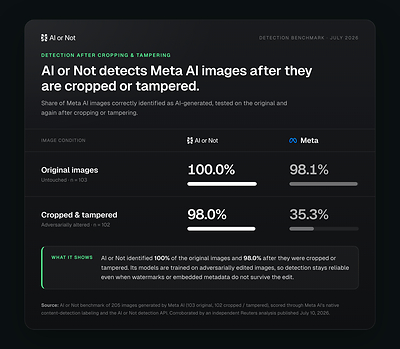
The benchmark, conducted by AI or Not, tested 205 Meta AI images across two conditions, untouched (normal) and cropped/tampered, running each image through both Meta AI’s own content-detection labeling and AI or Not’s detection API. On original images both approaches perform near their ceiling. After the images are cropped and tampered, AI or Not’s detection rate stays at 98.0%, while Meta AI’s native labeling identifies 35.3%.
BENCHMARK RESULTS
Detection rate, AI or Not compared with Meta AI’s native labeling:
- Normal (untouched) images, n=103: AI or Not 100.0%; Meta AI 98.1%
- Cropped / tampered images, n=102: AI or Not 98.0%; Meta AI 35.3%
Chart: AI or Not and Meta AI detection benchmark. On original Meta AI images both identify near their ceiling (AI or Not 100.0%, Meta AI 98.1%); after cropping or tampering AI or Not holds at 98.0% and Meta AI is at 35.3%.
Key takeaway: AI or Not’s detection rate stayed nearly flat after cropping and tampering, moving from 100% to 98.0%. Meta AI’s native labeling identified 98.1% of the original images and 35.3% after the same edits. Detection that is trained against adversarial manipulation stays reliable after the edits that can strip watermarks and metadata.
DETECTION BREAKDOWN BY CONDITION
AI or Not: detection accuracy and confidence (detected / total, detection rate, average AI confidence)
- Normal images: 103 / 103, 100.0%, 97.3%
- Cropped batch 1 (landscapes/scenes): 50 / 52, 96.2%, 92.2%
- Cropped batch 2 (portraits/food/objects): 50 / 50, 100.0%, 95.5%
- Cropped, combined: 100 / 102, 98.0%, ~93.8%
Meta AI: detection accuracy (detected / total, detection rate)
- Normal images: 101 / 103, 98.1%
- Cropped batch 1 (landscapes/scenes): 5 / 52, 9.6%
- Cropped batch 2 (portraits/food/objects): 31 / 50, 62.0%
- Cropped, combined: 36 / 102, 35.3%
AI or Not stayed above 96% across every cropped batch. Meta AI’s native labeling of cropped images varied by content type, identifying 9.6% of cropped landscape and scene images and 62.0% of cropped portraits, food, and objects.
INDEPENDENT CORROBORATION: REUTERS REACHES THE SAME CONCLUSION
AI or Not’s findings align with an independent Reuters analysis published July 10, 2026 (“Meta AI image detector fails to identify some of its own cropped AI images, Reuters analysis finds,” https://www.reuters.com/business/meta-ai-image-detector-fails-identify-some-its-own-cropped-ai-images-reuters-2026-07-10/), which tested 40 images generated with Meta’s Muse Image model and found that Meta’s detection tool verified all of the original images, and verified 45% of the same images once cropped. Meta’s invisible watermarking system, Content Seal, is embedded in every Muse Image and is designed to survive cropping, compression, resizing, and screenshotting. Meta told Reuters the tool was a preview and that the watermark’s signal “may be lost if an image is heavily cropped.”
The Reuters analysis also cited independent academic experts on the structural limits of watermark-based approaches. Siwei Lyu, a computer science professor at the State University of New York at Buffalo who researches AI image forensics, told Reuters: “Watermark-based methods can be highly effective when the watermark remains intact, but any modification that removes or weakens the embedded signal – such as cropping, resizing, heavy compression, or editing – may reduce their effectiveness, depending on how the watermark is designed.”
Two separate tests, one by AI or Not across 205 images and one by Reuters across 40, point to the same finding: watermark- and metadata-based detection is sensitive to common image edits such as cropping, while detection that reads the image content stays reliable.
WHY IT MATTERS
The finding reflects a known limitation of provenance-based signals during a period of heightened risk, including the U.S. midterm election cycle. Watermarks and metadata are applied at the moment of creation, and they can be broken or stripped by the everyday actions that AI-generated images undergo before they spread, such as cropping, screenshotting, re-encoding, and resizing. Bad actors exploit exactly this gap. A detection layer that reads the image itself, rather than a label attached to it, is what remains when provenance signals are gone.
Anatoly Kvitnitsky, CEO and Founder of AI or Not, stated:
“Watermarks and provenance metadata like C2PA are genuinely excellent for one job, confirming an AI image at the moment it’s created. Think of them as the birth certificate for original AI content. But the second someone crops, screenshots, or re-encodes that image, those signals can break or be stripped away entirely, and that is precisely the gap adversaries attack. Purpose-built models like AI or Not’s are trained specifically against those adversarial manipulations, so they keep detecting the AI image itself, not just the label that was attached to it. When an image is tampered with, detection that reads the signals within the image itself is what keeps working.”
METHODOLOGY
- Images tested: 205 Meta AI images, split into 103 in untouched (normal) condition and 102 in cropped/tampered condition.
- Detectors compared: Meta AI’s native content-detection labeling and AI or Not’s detection API.
- Conditions: Each image was evaluated in its original form and after cropping/tampering. Detection was scored as a binary detected/undetected outcome per image, with AI or Not confidence scores recorded.
- Data integrity: Every reported percentage reconciles exactly to the underlying image and record counts. No image was double-counted or dropped. Meta AI results were scored from the authoritative detection spreadsheet, and AI or Not results were captured per-image via its reporting output.
- Data availability: Full per-image results, detection screenshots, and source files are available for review at: https://drive.google.com/drive/folders/1W2PqTHRwc6PgZdxt_zk17poVp028oIoJ?usp=sharing
FREQUENTLY ASKED QUESTIONS
Can cropping or tampering cause AI-image detection to miss an image?
It depends on how the detector works. Provenance-based methods, such as invisible watermarks and C2PA metadata, read a signal added when an image is created, and that signal can weaken or disappear when the image is cropped, screenshotted, resized, or re-encoded. In AI or Not’s benchmark, Meta AI’s native content-detection labeling identified 98.1% of original Meta AI images and 35.3% of them after they were cropped and tampered. Detection that analyzes the image content itself is not tied to an embedded signal, so it keeps working after those edits.
How well does Meta AI’s own detection identify its own images after they are cropped?
In AI or Not’s benchmark of 205 Meta AI images, Meta AI’s native labeling identified 98.1% of the untouched images and 35.3% of the cropped and tampered set. On cropped images, results varied by content type: 9.6% of landscape and scene images and 62.0% of portraits, food, and objects. An independent Reuters analysis published July 10, 2026 reached a similar conclusion, finding that Meta’s detection tool verified all of the original images and 45% once they were cropped.
How accurate is AI or Not at detecting cropped and tampered Meta AI images?
In the same benchmark, AI or Not identified 100% of the original Meta AI images as AI-generated and 98.0% after they were cropped and tampered. It stayed above 96% across every cropped batch (96.2% and 100.0%). Each image was scored against both Meta AI’s native labeling and the AI or Not detection API.
Why do watermarks and metadata become less reliable when an image is edited?
Watermarks and C2PA Content Credentials are applied at the moment an image is created, so they work best on an original, unaltered file. The everyday actions images undergo before they spread, such as cropping, screenshotting, re-encoding, and resizing, can weaken or remove the embedded signal. That is a known limitation of provenance-based methods, and it is why AI or Not is valuable as an additional layer: it reads the signals within the image itself, so it can still identify an AI image after the provenance signal is gone. The two approaches work best together.
What are the real-world risks of cropped or tampered AI images?
AI images rarely spread in their original form. They are cropped, screenshotted, and re-encoded as they move across social platforms and messaging apps, which is exactly when provenance signals can be lost. That gap matters most during high-stakes moments such as the U.S. midterm election cycle, when an image can circulate widely before its origin is verified. The practical risks include election and political misinformation, insurance fraud and KYC deepfakes, and reputational harm from fake images presented as authentic.
What can platforms, newsrooms, and enterprises do to protect against manipulated AI images?
No single method is sufficient. Effective protection combines provenance standards such as watermarking and C2PA for original content, with content-based detection that is trained against adversarial attacks, like AI or Not.
Are watermarking and C2PA metadata still useful?
Yes. Watermarks and C2PA Content Credentials are highly effective for verifying original, unaltered AI content and are a valuable part of a provenance stack. Their limitation is durability once an image is edited. Provenance and trained detection are complementary: provenance confirms origin at the moment of creation, and content-based detection, such as AI or Not’s, identifies AI images after they have been altered.
ABOUT AI OR NOT
AI or Not is the leading AI detection API for images, text, audio, video, and deepfakes. Powered by industry-leading models that deliver 98.9% accuracy, the API enables developers, businesses, and enterprises to embed synthetic media detection directly into their products and workflows. Trusted across a wide range of industries and use cases, from media and fintech to fraud prevention and identity verification, AI or Not is built for speed, precision, and scale. Learn more at aiornot.com.

 View original content to download multimedia:https://www.prnewswire.com/news-releases/ai-or-not-detects-100-of-meta-ai-images-and-holds-98-accuracy-after-those-images-are-cropped-or-tampered-302829352.html
SOURCE AI or Not


