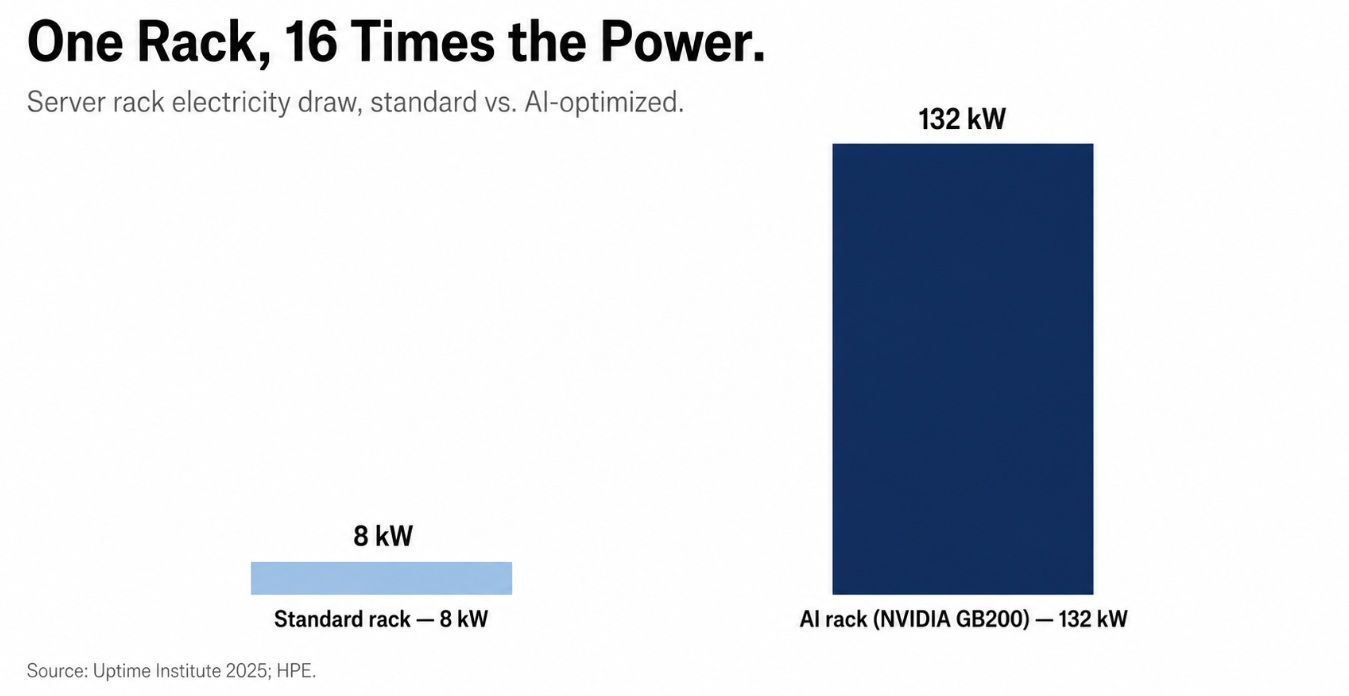
The per-rack power jump behind the data center buildout, plus the cooling and grid investment it requires, traces to everyday consumer and business use of AI.
PITTSBURGH, PA, UNITED STATES, July 20, 2026 /EINPresswire.com/ — The electricity behind artificial intelligence starts inside a single equipment rack, and the numbers there explain the rest. For years a conventional server rack in a data center drew under 10 kilowatts of power. The Uptime Institute reported an industry average near 8 kilowatts in its 2025 survey. A rack built for AI now dwarfs that. NVIDIA’s GB200 NVL72, a flagship system for training and running large AI models, packs 72 graphics processing units and 36 central processors into one liquid-cooled rack. Hewlett Packard Enterprise and Uptime both list its power draw at 132 kilowatts. That is more than 16 times a standard rack, in the same floor footprint. The Uptime Institute calls that density extreme, noting that only about 1% of operators run racks above 100 kilowatts today.
The climb is not finished. Schneider Electric, cited in Uptime’s 2025 survey, projects the next generation of these systems will require even more, on the order of 240 kilowatts per rack. This is the physical reason the current data center construction wave is reshaping electricity demand. The load is not the product of any single company or policy. It is the direct result of consumers and businesses adopting AI tools across everyday work and daily life.
The Lawrence Berkeley National Laboratory, in a December 2024 report for the U.S. Department of Energy, traced the shift. Data center electricity use held roughly steady for years, then climbed sharply as AI workloads spread. The laboratory found that data centers consumed about 4.4% of all U.S. electricity in 2023 and projected that share could reach between 6.7% and 12% by 2028, a rise from 176 terawatt-hours to between 325 and 580 terawatt-hours within five years.
A facility multiplies the rack figure many times over. The Congressional Research Service defines a hyperscale data center as one holding at least 5,000 servers across 10,000 square feet or more. Fill a large hall with high-density AI racks and the computing load alone reaches into the tens of megawatts. A single megawatt is 1,000 kilowatts, so a hall running a few hundred of these racks draws as much power as a small town.
Then comes the heat. The Congressional Research Service reports that cooling can account for another 38% to 40% of a data center’s total electricity use, with roughly half or more coming from the computing hardware itself. Every watt a chip draws becomes heat that has to be removed, and removing it costs nearly as much power again. Air cooling cannot keep pace with racks above 40 kilowatts, so operators are shifting to liquid systems that pipe coolant directly to the chips. HPE’s specification for the GB200 rack splits its draw into 115 kilowatts of liquid cooling and 17 kilowatts of air. The racks weigh more than a metric ton each, and their floor loading and cooling demands often require purpose-built space.
The obvious question is why operators pack chips this tightly when the cooling burden is so steep. The answer is speed. Training a large AI model requires its processors to exchange data constantly, and the closer they sit, the faster they communicate. Concentrating dozens of chips in one rack, then cooling the result with liquid, produces more useful work than spreading them across a room. Efficiency gains do not slow the climb either. Chips grow more efficient each generation, and Google reported a large drop in energy used per AI query in 2025, yet total consumption keeps rising because cheaper, faster AI simply gets used more. Economists call it the rebound effect.
There is a further reason demand stays high. The Congressional Research Service describes the memory wall, the energy lost when data moves between a processor and a separate memory chip. A large share of AI power goes to shuttling information back and forth rather than to the calculation itself. The result is a heavy, around-the-clock electricity load that does not ease when a single task finishes.
Serving that load takes more than power plants. Electricity rates reflect the cost of generating power and the cost of delivering it through transmission and distribution systems, and meeting the new demand requires expanding both. Utilities are building new high-voltage lines, substations, and grid connections to reach the sites where data centers are rising, and that expansion is a major driver of investment in its own right. When a utility invests capital in new generation or grid upgrades, regulators adjust rates to reflect it. The Congressional Research Service noted in its May 2026 analysis that, so far, little evidence showed data center demand affecting electricity rates nationwide.
The geographic pattern is uneven. Data center construction has concentrated in a handful of states, among them Virginia, Texas, Arizona, Ohio, Georgia, and Oregon, where land, tax treatment, and grid access align. Pennsylvania sits inside the PJM Interconnection, the regional grid operator that serves 13 states, which places the state’s power supply and its housing markets inside the same system now absorbing rising data center demand.
For housing, the connection is indirect but real. The same regional grids, skilled electrical trades, and buildable land that serve data centers also serve residential construction. Companies that buy houses across western Pennsylvania operate inside these same regional markets, where power supply, land, and labor set the pace of construction. None of this points back to a single decision that could be reversed. The demand traces to broad, everyday use of AI, social media, and automation across the economy. Understanding the engineering behind AI data center power, rack by rack, makes the scale of the challenge easier to see.
About
Buys Houses is a Pittsburgh cash buyer that purchases residential properties directly from owners across western Pennsylvania. The company works with homeowners selling inherited, distressed, and as-is properties who prefer a direct cash sale. More information is available at Buys Houses. Homeowners who need to sell house now, including those managing inherited or distressed properties, can request a direct cash offer from the company.
Carlo Finotti
Buys Houses
+1 412-561-9833
media@BuysHouses.co
Legal Disclaimer:
EIN Presswire provides this news content “as is” without warranty of any kind. We do not accept any responsibility or liability
for the accuracy, content, images, videos, licenses, completeness, legality, or reliability of the information contained in this
article. If you have any complaints or copyright issues related to this article, kindly contact the author above.

Media gallery