Biological Safety Cabinet Market to Surge from USD 280.6 Mn in 2025 to USD 619.4 Mn by 2035—By Cell & Gene Therapy Capacity Buildout, CDMO Outsourcing Expansion
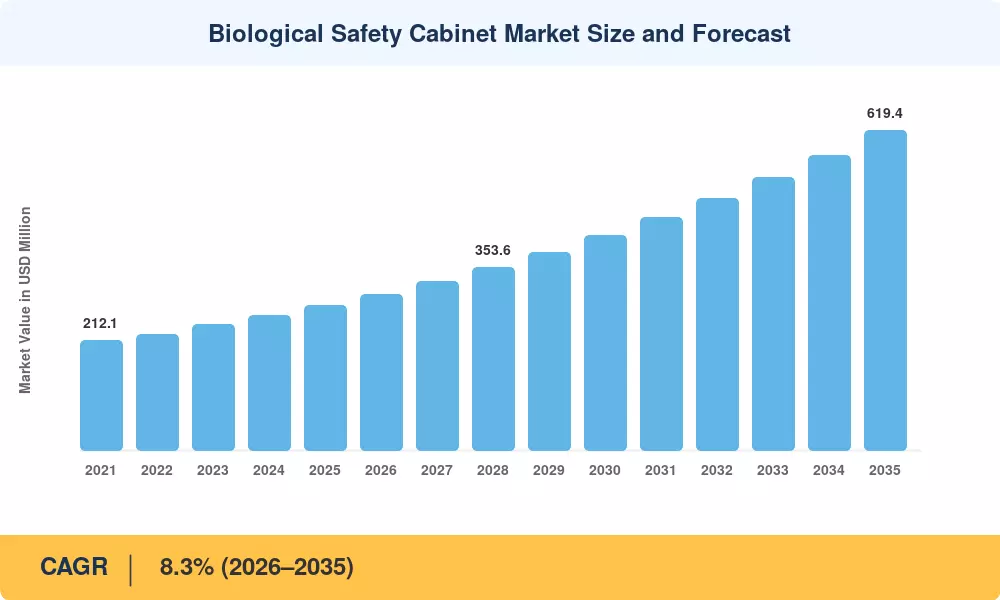
NY, CA, UNITED STATES, August 28, 2026 /EINPresswire.com/ — As per Market Research Future, the global Biological Safety Cabinet Market size is projected to reach USD 619.4 Million by 2035 from USD 280.6 Million in 2025, at a CAGR of 8.3% during the forecast period 2026–2035. The market base was estimated at USD 280.6 Million in 2025, with the first year of the forecast period (2026) valued at USD 302.3 Million.
The 8.3% CAGR—anchored by structural shifts in biopharmaceutical manufacturing and containment infrastructure—is propelled by three converging forces: large-scale biopharmaceutical manufacturing capacity expansion, with Novo Nordisk’s USD 4.1 billion fill-finish campus and Thermo Fisher Scientific’s USD 2 billion U.S. capacity program converting what was previously a slow equipment replacement cycle into a genuine buildout of containment infrastructure; the rapid expansion of cell and gene therapy production, which consumes containment hardware at roughly three times the density of conventional small-molecule laboratories; and regulatory convergence through harmonisation between NSF/ANSI 49, EN 12469 and ISO 14644-4, cutting dual-certification engineering work that once added 8–12% to project cost on multinational builds.
Regulatory and industry initiatives are amplifying this momentum. The EU Machinery Regulation 2023/1230, effective January 2027, tightens safety-function documentation requirements, accelerating replacement cycles in European academic institutions. Global Contract Development and Manufacturing Organization (CDMO) capital expenditures continue to expand significantly, with procurement decisions shifting away from individual principal investigators toward central engineering and procurement teams negotiating multi-year framework agreements. The FDA’s Office of Therapeutic Products (OTP) oversees a continuous advancement of the regulatory pipeline, driving sustained commercial-scale suite construction. These forces are creating the procurement infrastructure and innovation on which the Biological Safety Cabinet Market depends.
Request A Free Sample:
https://www.marketresearchfuture.com/sample_request/6064
Key Market Trends & Growth Drivers
Advanced Therapy Manufacturing Scale-Up
Autologous and allogeneic therapy suites require containment at every open-process step. While facility layouts vary based on specific therapeutic pipelines and modular cleanroom designs, modern cell therapy plants feature significantly higher densities of biosafety enclosures compared to traditional small-molecule manufacturing facilities. The continuous advancement of the regulatory pipeline—overseen by the FDA’s Office of Therapeutic Products (OTP)—drives sustained commercial-scale suite construction, serving as a primary structural support for the global Biological Safety Cabinet Market.
CDMO Outsourcing Expansion
Sponsors increasingly opt to rent capacity rather than construct greenfield manufacturing plants. Global CDMO capital expenditures continue to expand significantly, and outsourced facilities standardise on fewer cabinet SKUs across multiple international sites to streamline maintenance and validation. Consequently, procurement decisions have increasingly shifted away from individual principal investigators toward central engineering and procurement teams negotiating multi-year framework agreements. CDMOs represent the fastest-growing end-user segment at a 12.1% CAGR through 2035.
Regulatory Convergence and Compliance
Harmonisation between NSF/ANSI 49, EN 12469 and ISO 14644-4 has cut dual-certification engineering work that once added 8–12% to project cost on multinational builds. Suppliers holding all three listings now win tenders that were previously fragmented by geography. The EU Machinery Regulation 2023/1230, effective January 2027, resets safety-function documentation requirements for laboratory equipment, with retrofit projects in European academic institutions alone anticipated to represent USD 190 million of addressable spend through 2030.
Energy Cost Pressure and Retrofit Demand
A hard-ducted cabinet running continuously can consume USD 1,900 to USD 2,600 annually in conditioned-air makeup in a temperate climate. DC-motor recirculating designs cut that by roughly 60%, and UK and German estate managers have used the payback maths to justify early replacement of units with five years of service life remaining. Recirculating (ductless) exhaust configurations are growing at an 11.0% CAGR, favoured in retrofit environments.
Ask for Customization:
https://www.marketresearchfuture.com/ask_for_customize/6064
Market Segment Insights
BY TYPE
Class II: Dominant segment with 56.6% share in 2025, still the default containment tier for aseptic work. Class II protects operator, product and environment simultaneously—the only configuration acceptable for open cell culture. Type A2 dominates unit volume while Type B2 wins wherever volatile chemistry is involved.
Class III: Fastest-growing segment at 10.7% CAGR (2026–2035) , driven by BSL-3 and BSL-4 network expansion. Class III glovebox systems represent a smaller but fast-compounding tier, driven by expanding high-consequence pathogen research and biosecurity rules.
Class I: Significant segment at USD 42.6 Million in 2025, providing basic personnel protection in teaching labs.
BY EXHAUST SYSTEM
Ducted (Hard-Connected): Largest segment with 53.9% share in 2025, driven by volatile chemical handling requirements.
Recirculating / Ductless: Fastest-growing segment at 11.0% CAGR (2026–2035) , driven by retrofit flexibility and energy savings. Retrofit projects rarely permit new roof penetrations, and avoided makeup-air load makes the business case straightforward.
BY APPLICATION
Drug Discovery & Pre-Clinical R&D: Largest segment with 34.5% share in 2025, supported by sustained biotech research budgets.
Biopharmaceutical Manufacturing & Fill-Finish: Fastest-growing application at 11.7% CAGR (2026–2035) , driven by aseptic capacity expansion. Fill-finish suites specify higher-grade units with integrated decontamination ports, and each new commercial line typically orders in batches of 12 to 30.
Clinical & Diagnostic Testing: Significant segment at USD 60.1 Million in 2025, driven by molecular diagnostics volume.
Academic Teaching & Public Health Labs: Holds 17.3% share in 2025, driven by compliance-driven replacement.
BY END USER
Pharmaceutical & Biotechnology Companies: Largest segment with 44.7% share in 2025, driven by in-house pipeline manufacturing.
Contract Development & Manufacturing Organisations (CDMOs): Fastest-growing end-user at 12.1% CAGR (2026–2035) , driven by outsourced capacity growth. CDMOs purchase in standardised multi-site lots and negotiate on service coverage rather than unit price.
Academic & Research Institutes: Significant segment at USD 62.6 Million in 2025, driven by grant-funded facility renewal.
Hospitals & Diagnostic Laboratories: Holds 14.4% share in 2025, driven by accreditation requirements.
Read Detailed Insights:
https://www.marketresearchfuture.com/reports/biological-safety-cabinet-market-6064
Regional Outlook
North America — Dominant Market (~39.1% Share, 2025)
United States: Generates approximately 84.2% of North American revenue, driven by NIH and BARDA facility grants. Federal funding sets the tempo here, with BARDA’s Industrial Base Expansion allocations and NIH C06 construction grants together releasing more than USD 780 million for laboratory infrastructure between 2023 and 2025.
Canada: Contributes USD 11.5 Million, driven by the Biomanufacturing and Life Sciences Strategy and vaccine sovereignty programme.
Mexico: Fastest-growing in the region at 8.6% CAGR, driven by nearshored contract manufacturing.
Europe — Second Largest (USD 76.9 Million, 2025)
Germany: Holds 23.8% of regional share, driven by biologics and vaccine plant upgrades.
United Kingdom: Contributes USD 14.1 Million, driven by the Life Sciences Innovative Manufacturing Fund (USD 660 million).
France: Holds 15.4% of regional share, driven by the France 2030 health programme.
Italy: Contributes USD 7.9 Million, driven by CDMO fill-finish expansion.
Spain: Holds 7.6% of regional share, driven by regional cluster investment.
Nordic Countries: Contribute USD 5.4 Million, driven by energy-efficiency retrofits.
Russia: Holds 4.1% of regional share, driven by domestic substitution mandates.
Rest of Europe: Contributes USD 10.4 Million, driven by academic estate renewal.
Asia-Pacific — Fastest-Growing Region (9.9% CAGR, 2026–2035)
China: Holds 31.2% of regional share, driven by domestic biologics scale-up.
India: Fastest-growing in the region at 11.4% CAGR, driven by the PLI scheme for biopharmaceuticals (cumulative disbursements crossed USD 1.1 billion by mid-2025).
Japan: Contributes USD 12.6 Million, driven by regenerative medicine facilities.
South Korea: Holds 9.8% of regional share, driven by CDMO capacity additions (added more than 340,000 litres of bioreactor capacity between 2023 and 2025).
ASEAN: Growing at 10.6% CAGR, driven by vaccine self-sufficiency programmes.
South America — Growing Presence (USD 14.6 Million, 2025)
Brazil: Anchors the region at 54.8% of revenue, driven by Fiocruz laboratory network upgrades (roughly USD 420 million in federal health infrastructure allocation).
Argentina: Contributes USD 3.1 Million, driven by biosimilar manufacturing.
Middle East & Africa — Emerging Opportunity (3.5% Share, 2025)
Saudi Arabia: Contributes USD 2.9 Million, driven by Vision 2030 biotech localisation.
UAE: Holds 21.4% of regional share, driven by the precision medicine programme.
South Africa: Contributes USD 1.9 Million, driven by the Afrigen mRNA hub.
Egypt: Growing at 9.4% CAGR, driven by the vaccine manufacturing initiative.
Competitive Landscape and Recent Developments
The Biological Safety Cabinet Market exhibits moderate concentration, with the top 5 providers accounting for about 48-53% of global revenue. Below this tier, a long tail of regional manufacturers compete on lead time and local certification support, making service coverage the major differentiator rather than product specification.
KEY COMPANIES AND RECENT MILESTONES
Thermo Fisher Scientific: Bundles containment with broader instrument estate. Class II A2/B2 cabinets and integrated lab packages. Estimated ~13–16% revenue share.
Esco Lifesciences Group: Full Class I–III range and isolators. Strongest Asia-Pacific manufacturing footprint. Estimated ~10–13% revenue share.
Labconco Corporation: Deep North American academic channel. Class II cabinets and enclosures. Estimated ~7–10% revenue share.
The Baker Company: Engineering-led containment specialist. High-performance Class II and Class III. Estimated ~6–9% revenue share.
NuAire Inc.: Custom configuration strength. Class II A2/B2 and animal transfer stations. Estimated ~5–8% revenue share.
Kewaunee Scientific (November 2024): Announced a capacity investment at its Indian manufacturing site to serve domestic pharmaceutical demand. Cabinets with laboratory furniture systems. Estimated ~4–6% revenue share.
Haier Biomedical: Price-competitive emerging-market reach. Class II cabinets with cold chain integration. Estimated ~3–6% revenue share.
Germfree Laboratories (September 2024): Delivered mobile BSL-3 laboratory units to an African public health network under a donor-funded surveillance programme. Leader in deployable BSL-3 units. Estimated ~3–5% revenue share.
Air Science USA: Retrofit and carbon-filtration niche. Ductless cabinets and filtration systems. Estimated ~3–5% revenue share.
Azbil Telstar: Pharma project engineering focus. Cabinets, isolators, and cleanroom systems. Estimated ~2–4% revenue share.
Berner International: European compliance specialist. Class II cabinets and cytotoxic workstations. Estimated ~2–4% revenue share.
Recent Industry Developments:
Novo Nordisk (March 2024): Announced a USD 4.1 billion fill-finish campus in North Carolina, one of the largest single aseptic capacity commitments on record.
Thermo Fisher Scientific (July 2023): Committed USD 2.0 billion to expand U.S. manufacturing and R&D capacity.
European Commission (July 2023): Regulation 2023/1230 entered into force, resetting safety-function documentation requirements for laboratory equipment ahead of the January 2027 application date.
NSF International (May 2024): Published updated NSF/ANSI 49 annexes clarifying field certification intervals and airflow test tolerances.
Future Outlook: 2026–2035
The Biological Safety Cabinet Market is projected to reach USD 619.4 Million by 2035, growing at a CAGR of 8.3%, driven by cell and gene therapy capacity buildout, CDMO expansion, and regulatory convergence.
New opportunities lie in:
Connected Cabinets and Service Revenue: Airflow telemetry, filter-loading prediction and audit-ready electronic logs turn a capital sale into a recurring contract. Suppliers piloting subscription monitoring report attach rates near 30% on new placements.
India and Southeast Asia Capacity Gap: Pharmaceutical supply chain rebalancing has pushed India’s formulation and biologics capex to an estimated USD 3.7 billion in 2025, yet domestic containment equipment supply remains import-dependent.
Modular and Mobile Containment: Prefabricated BSL-3 modules for outbreak response and decentralised trial sites bundle cabinets, air handling and validation into one procurement line. Public health agencies across Africa committed roughly USD 240 million to laboratory network strengthening between 2023 and 2025.
Low-GWP and Energy-Rated Product Lines: Procurement scorecards now weight lifecycle energy. Cabinets carrying verified consumption data win points in EU public tenders under revised green procurement criteria.
Aftermarket Filter and Decontamination Services: Filter replacement, vaporised hydrogen peroxide gassing and annual certification together represent an estimated 22% of ten-year ownership cost. Capturing that stream through bundled service contracts stabilises revenue against capital cycles.
By 2035, the Biological Safety Cabinet Market is expected to demonstrate robust growth, reflecting evolving biopharmaceutical manufacturing capabilities, regulatory compliance requirements, and the continued expansion of containment infrastructure worldwide.
More Related Research Insights:
https://www.marketresearchfuture.com/reports/mental-health-market-12354
https://www.marketresearchfuture.com/reports/orphan-drugs-market-2312
https://www.marketresearchfuture.com/reports/medical-billing-outsourcing-market-7621
https://www.marketresearchfuture.com/reports/prefilled-syringes-market-6167
https://www.marketresearchfuture.com/reports/medical-simulation-market-12330
https://www.marketresearchfuture.com/reports/proton-pump-inhibitors-market-19223
https://www.marketresearchfuture.com/reports/hla-typing-market-21479
https://www.marketresearchfuture.com/reports/pain-management-market-5975
https://www.marketresearchfuture.com/reports/medical-sensors-market-2038
https://www.marketresearchfuture.com/reports/neurorehabilitation-devices-market-2210
Market Research Future
Market Research Future
+1 855-661-4441
email us here
Legal Disclaimer:
EIN Presswire provides this news content “as is” without warranty of any kind. We do not accept any responsibility or liability
for the accuracy, content, images, videos, licenses, completeness, legality, or reliability of the information contained in this
article. If you have any complaints or copyright issues related to this article, kindly contact the author above.

Media gallery