
Government-led program rebuilt homes, infrastructure, schools and historic city centers across 11 provinces in under three years
ISTANBUL, TR — October 15, 2026 — Nearly three years after one of the deadliest disasters in Türkiye’s modern history, a government-led reconstruction program has completed 455,357 housing and commercial units, along with infrastructure, schools, commercial districts and historic city centers across the earthquake-affected region.
Two powerful earthquakes struck southern Türkiye on Feb. 6, 2023, nine hours apart, devastating cities across a wide stretch of the country and neighboring Syria. Türkiye’s Disaster and Emergency Management Authority (AFAD) measured the earthquakes at magnitudes 7.7 and 7.6. According to official figures, 53,537 people were killed in Türkiye and more than 107,000 were injured. About 14 million people were directly affected across the country’s earthquake-hit provinces. [Source: AFAD]
In the months after the earthquakes, approximately 8,000 government personnel inspected 2.19 million buildings containing 5.92 million individual units. The Ministry of Environment, Urbanization and Climate Change ultimately classified about 850,000 residential, commercial and other units as unusable.
Rebuilding Began as Debris Removal Continued
The national reconstruction program was coordinated by the Ministry of Environment, Urbanization and Climate Change, working with the Housing Development Administration (TOKİ), the Urban Transformation Presidency, Emlak Konut REIT and the General Directorate of Construction Affairs. Officials refer to the effort as the “Reconstruction Mobilization of the Century.”
Foundations for the first permanent housing were laid 15 days after the earthquakes, and the first village homes were handed over on the 45th day. At the program’s peak, about 200,000 architects, engineers and construction workers were active at 3,481 construction sites across 174 locations, with output reaching the equivalent of 23 housing units an hour, or 550 a day. These figures reflect combined production across thousands of projects, not the construction time of an individual home. [Source: Ministry of Environment]
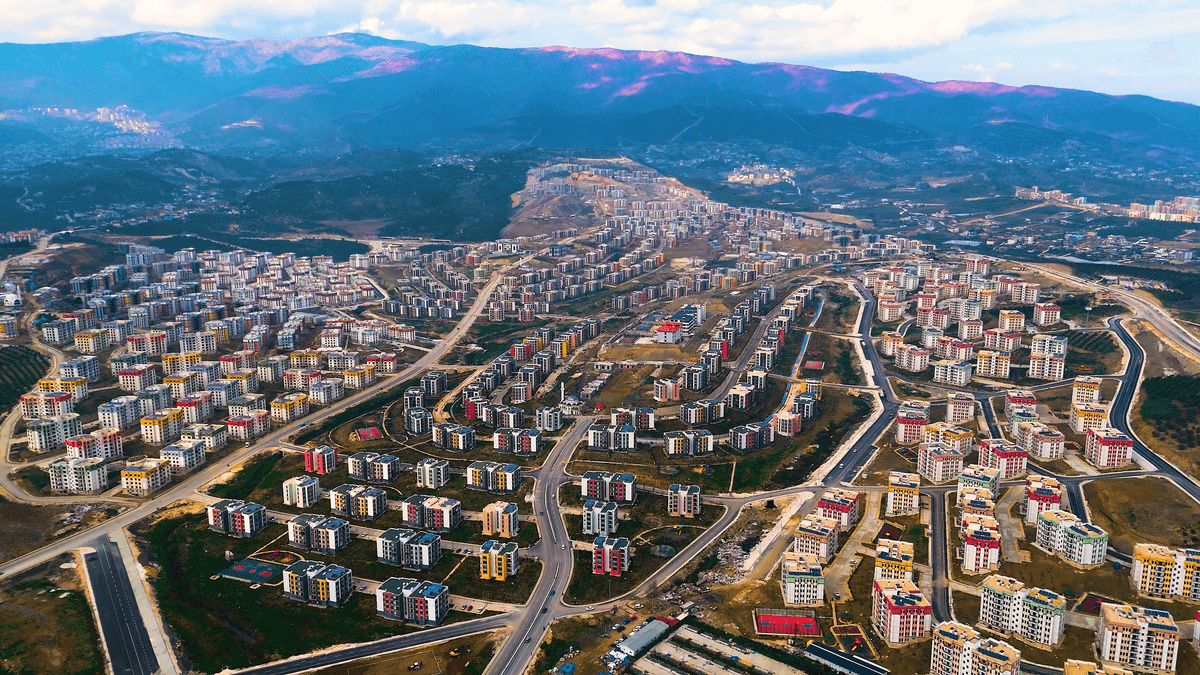
Among the largest projects was İkizce in Malatya province, where 28,289 units were planned. Other major developments included İndere in Adıyaman, Dikmece in Hatay and Altınova in Kahramanmaraş. At İndere, a new residential district with 16,822 housing and commercial units and supporting infrastructure was developed for a population of roughly 100,000.
455,357 Units Completed by the End of 2025
At a ceremony in Hatay on Dec. 27, 2025, attended by President Recep Tayyip Erdoğan, the government announced that the main construction program had reached 455,357 completed units: 367,995 conventional housing units, 65,672 village homes and 21,690 commercial units. [Source: TOKİ]
The same program included the opening of 157 public investments, including 84 education buildings.
In addition to state-built housing, an “On-Site Transformation” program supported property owners who chose to rebuild on their original land. Financial support has been provided for about 124,000 additional units through this program, separate from the 455,357-unit total.
Minister of Environment, Urbanization and Climate Change Murat Kurum has described the program not simply as a housing project, but as an effort to rebuild functioning communities and make them more resilient to future disasters.
Infrastructure and Historic City Centers
The earthquakes damaged not only buildings but also water, sewer and stormwater networks. Work has been carried out on roughly 6,800 miles of drinking water, wastewater and stormwater lines across the affected region.
In Hatay, reconstruction extended to the historic Uzun Bazaar, Kurtuluş Avenue, the former parliament building and structures along the Asi River. The Uzun Bazaar project includes 1,536 residential and commercial units, and 280 shops were rebuilt along Kurtuluş Avenue.
Similar work in Malatya, Kahramanmaraş and Adıyaman developed housing, retail space, offices and public buildings side by side, with the aim of restoring economic activity in city centers as well as replacing lost homes.
Rebuilding the Coast in İskenderun
In İskenderun, where parts of the coastline subsided by about 31 inches during the earthquakes, the Ministry launched a major coastal rehabilitation project. Its first phase covered about 2.2 miles of coastline and roughly 75 acres, combining shoreline restoration with new public spaces.
The Cost of Rebuilding
President Erdoğan has said public spending on the earthquake response reached about 3.6 trillion Turkish lira, or roughly $90 billion, covering housing, infrastructure and other recovery programs. He has put the earthquakes’ direct economic cost at $104 billion and their indirect cost at $150 billion.
Erdoğan has described the reconstruction as a collective national effort involving government institutions, municipalities, civil society, workers and residents of the affected provinces.
A Program Measured in Communities
Taken together, the figures show the scale of the effort: millions of properties inspected, hundreds of thousands deemed unusable, 455,357 replacement housing and commercial units completed and about 124,000 more supported through on-site rebuilding. For Türkiye’s authorities, the long-term measure of recovery will be not only the number of keys handed over, but how the new neighborhoods and infrastructure perform over time.
###
Media Contact
Company: IQLOOP Group
Contact Person: IQLOOP Agency
Email: Send email
Website: www.iqloopgroup.com


